


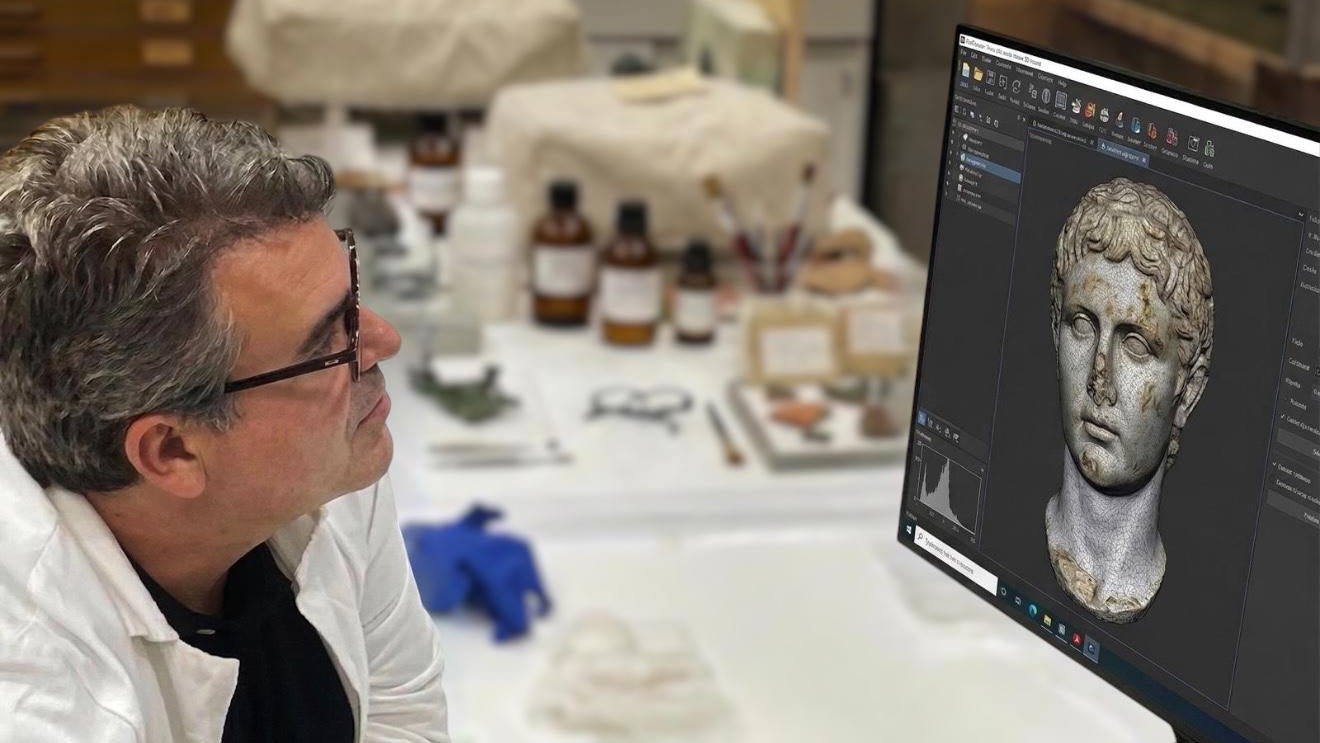
In the world of art restoration, every surface tells a story, and every touch risks altering it. For professional art conservator Davide Fodaro, Revopoint’s 3D scanners have become an indispensable part of safeguarding these stories. Davide specializes in the conservation of historical artworks. Let’s take a look at how he uses them.
Documenting and Reconstruction Art
One of the most important uses of scanning is documentation. Davide highlights how it captures details that are otherwise difficult to record. He says it’s “very useful, with adequate resolution, to scan portions of surfaces that are particularly rich in morphology and for recording of the execution techniques (traces, marks, etc.).”
These detailed scans create a digital record of the work, preserving its texture, marks, and execution techniques for study and future reference.

Scanning also transforms how missing or damaged parts are handled. "The possibility of creating lost parts without operating directly on the work is truly essential to respect the work of art,” Davide says. By digitally reconstructing missing elements, restorers can preserve the integrity of the original object while completing essential conservation work.
3D Scanning for Measurements and Planning
3D scanning enables restorers to safely obtain measurements that are nearly impossible with traditional methods. Davide points out that “precise measurements can be made, with estimates of the weight and density of materials that cannot be easily made on fragile objects.”
These measurements support careful planning, whether for creating conversation supports to ensure the artifacts can be safely displayed or for recreating structural elements. “In particular, the ability to use scans to create virtual casts of the surfaces and then create a support allows us to preserve the integrity of the work and achieve a better result,” he explains.

The benefits extend to efficiency and safety. “Scanners allow me to perform better and (sometimes) more quickly certain tasks that are particularly time-consuming with traditional methods: for example, filling in gaps and missing parts, with the not-so-secondary benefit of not touching the work.” Tasks that once required meticulous, hands-on labor can now be completed digitally, protecting delicate surfaces while saving time.
Selecting and Using Scanners Effectively
Davide emphasizes that the value of 3D scanning depends on choosing the right tool for the task and using it with care. He begins by noting, “Like all tools, how you use it matters, and proper planning is essential. I've adopted the good practice of performing preliminary tests to determine which scanner gives me the best results,” Davide notes.
Davide’s toolkit includes a variety of Revopoint scanners, giving him the flexibility to meet different scanning needs. “If I am in a museum, outdoors…..I choose….scanners that don't tie me to a computer, such as the Revopoint MIRACO, or extremely manageable solutions that can be operated directly from a smartphone, like the Revopoint INSPIRE,” he says.

When handling objects that demand exceptional precision, Davide adds, “If the object is small and the project requires a scan with an extreme level of detail and accuracy, my choice falls on blue-line laser technology, opting for models like the Revopoint MetroX Pro.”
The Power of the Digital Twin
Perhaps the most transformative effect is the creation of a digital twin. “Having a digital twin that documents the work in three dimensions has truly changed the way a work of art is preserved. With an accurate 3D model, in the event of an accident, we have a faithful copy that can be transformed from a digital and virtual object into a physical and real work of art,” Davide explains. This virtual record safeguards the artwork against damage or loss, providing a blueprint for restoration that preserves the original’s form and detail.

For Davide, 3D scanning is a powerful tool enabling him to perform his work to the highest standard. “They are tools that enhance the quality of work and allow for faster, better results, and often enable operations that cannot be achieved with traditional techniques.” By combining traditional craftsmanship with digital accuracy, 3D scanning ensures that these historical works can be preserved, studied, and appreciated for generations to come.


Hinterlasse einen Kommentar
Diese Website ist durch hCaptcha geschützt und es gelten die allgemeinen Geschäftsbedingungen und Datenschutzbestimmungen von hCaptcha.