


As 3D scanning technology becomes increasingly integrated into product design, mechanical engineering, and digital fabrication curricula, universities worldwide are seeking practical tools that students can adopt from day one. This article documents real classroom deployments in Japan, where Revopoint 3D scanners were used in accredited university programs.
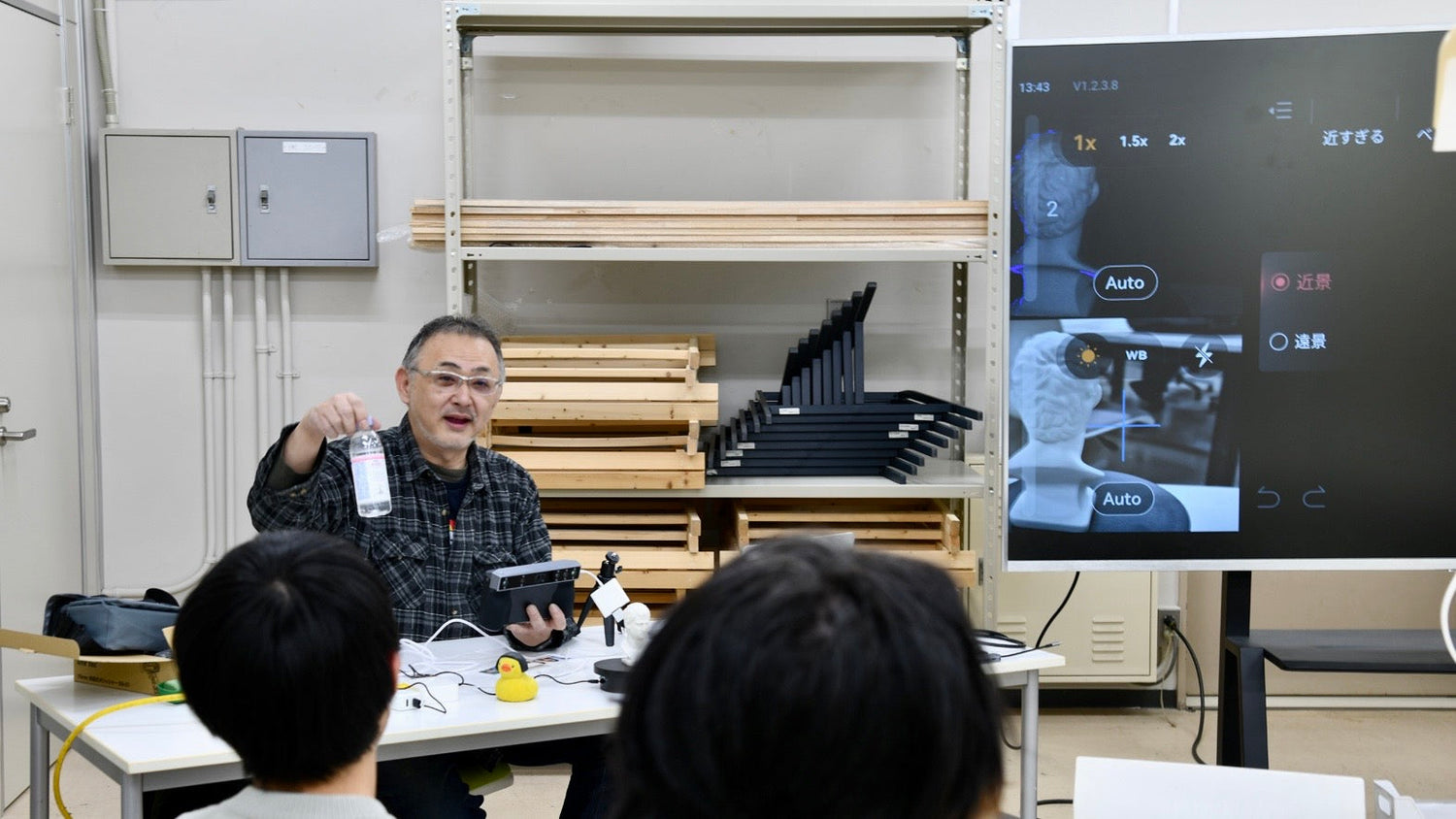
To explore this in practice, Revopoint invited Ryuji Oda of FULL DIMENSIONS STUDIO to lead hands-on 3D scanning sessions at the University of Tsukuba and Kyoto Saga University of Arts.
A 3D digital fabrication specialist, Oda has worked across 3D scanning, CAD, 3D CG, automotive interiors, product development, and exhibition models. His experience in both education and industry allows him to connect the technology with real design and fabrication workflows.
Learning by Scanning
At the University of Tsukuba's Sobo fabrication facility, Oda led a two-day MIRACO all-in-one 3D scanner workshop for 13 students and faculty members.
For many participants, it was their first hands-on experience with a 3D scanner. Rather than learning from a fixed workstation, students could handle the entire process directly on MIRACO—from scanning and basic processing to taking the data into CAD and ZBrush.
The standalone workflow proved particularly practical in a classroom setting. Key features that made MIRACO well-suited for education include:
Built-in touchscreen: all scanning and processing can be completed on-device, no laptop or workstation required
Up to 2 hours of battery life: students can move freely between objects without being tethered to a power source
Low barrier to entry: beginners can start scanning within minutes, without IT setup or driver installation

The focus, however, was not simply on operating the scanner. Oda also introduced different scanning techniques and showed students how the approach changes depending on the object.
“3D scanners will likely become essential tools for reverse engineering.”
— Ryuji Oda, FULL DIMENSIONS STUDIO
From Scanning to Design
MIRACO was also used at Kyoto Saga University of Arts during a practical class in the Department of Living Design.
Because scanning and initial processing are completed entirely on MIRACO's onboard system, students could export their 3D scan data directly to MacBook Pro computers and continue working in their existing 3D modeling and CAD workflows without compatibility issues or additional software installation.
“I had previously used scanners that were difficult to operate, but I am impressed by the usability of MIRACO.”
— Faculty member, Kyoto Saga University of Arts

When Precision Matters
Kyoto Saga University of Arts also evaluated MetroY Pro 3D scanner for more advanced applications.
The MetroY Pro's blue-laser scanning technology captured dark, reflective, and shiny surfaces without the need for scanning spray or surface preparation. Its 0.02 mm accuracy enabled students and faculty to take on demanding tasks such as reverse engineering of complex mechanical parts and detailed surface analysis.
Speed quickly became another practical advantage in the classroom. With scanning speeds of up to 2,000,000 points per second, MetroY Pro captures highly detailed scans in seconds, making it ideal for shared classroom environments where multiple students use the same device.
“The short time the scanner itself needs to be occupied makes it easy for students to take turns using it.”
— Faculty member, Kyoto Saga University of Arts
With Wi-Fi 6 for wireless scanning and data transfer, MetroY Pro can also fit more naturally into shared labs where several students may be working with the same equipment.

From the Classroom to Industry
The experiences at the University of Tsukuba and Kyoto Saga University of Arts show that the value of a 3D scanner for education goes beyond teaching students how to capture an object.
It gives students a practical way to connect the physical and digital worlds—following a complete workflow from initial 3D scan capture → CAD import → digital modeling → reverse engineering → physical fabrication. These are the same steps used in professional environments across manufacturing, automotive design, and product development.
As these workflows become increasingly common across modern industries, hands-on 3D scanning education can help students build skills that extend well beyond the classroom.
3D Scanner for Education: FAQs
What are the educational uses of 3D scanners for university students?
University students can use 3D scanners across a wide range of academic and practical applications, including:
Reverse engineering: digitizing existing parts to reconstruct CAD models
Product design: scanning physical prototypes for refinement in digital tools
Digital fabrication: converting scanned data into files for 3D printing or CNC machining
Engineering research: capturing complex geometry for structural or surface analysis
Art & cultural heritage: digitizing sculptures, artifacts, or architectural elements
In all cases, the core skill is converting a physical object into accurate 3D digital data.
What features should universities consider when choosing a 3D scanner for classrooms?
Ease of use, accuracy, scanning range, processing workflow, and how easily multiple students can share the equipment are key considerations.
Is the Revopoint MIRACO suitable for students and beginners with no 3D scanning experience?
Yes. The Revopoint MIRACO is designed with beginners in mind. Its standalone touchscreen workflow means students can scan and process data entirely on the device—no computer setup, no driver installation, and no prior technical experience required. In classroom deployments at the University of Tsukuba, first-time users were able to complete full scans within the first session.
What makes MetroY Pro suitable for advanced education?
Its 0.02 mm accuracy, blue-laser scanning, fast capture, and wireless workflow make it suitable for engineering, reverse engineering, research, and other precision-focused applications.
Are 3D scanning skills learned in university applicable to industry jobs?
Yes. The same workflows taught in the classroom are increasingly used in manufacturing, automotive design, product development, reverse engineering, digital fabrication, and cultural heritage.
Start Your 3D Scanning Program
Whether you're setting up a 3D scanning program from scratch or looking to upgrade your existing equipment, the experiences at the University of Tsukuba and Kyoto Saga University of Arts offer a practical reference point.
Revopoint MIRACO is built for accessibility—ideal for introductory courses, shared labs, and students with no prior scanning experience. Revopoint MetroY Pro steps in where precision is the priority, supporting reverse engineering, detailed surface analysis, and advanced fabrication workflows.
Back-to-School STEM: Bring 3D Scanning Into Your Next Project
Looking to bring hands-on 3D technology into the classroom, STEM program, or maker space? Our Back-to-School STEM promotion is a great time to get started.
Use code REVONEWS26 for an extra 2% off, for up to 22% off all 3D scanners.


Leave a comment
This site is protected by hCaptcha and the hCaptcha Privacy Policy and Terms of Service apply.