


Mid‑19th Century: Photogrammetry
The earliest form of 3D scanning was photogrammetry, developed in the 1850s by Aimé Laussedat, a French military engineer often regarded as the father of photogrammetry. He showed that overlapping photos could be analyzed to reconstruct geometric information about landscapes and structures.

By the late 19th century, photogrammetry was becoming common in cartography and surveying, especially for military maps. Photography could cover large areas more quickly than ground survey teams, reducing the time and effort needed to produce accurate maps.
1950s - 1970s: Origins of Industrial Metrology
Object 3D scanning started with coordinate measuring machines (CMMs), which Ferranti first developed in the UK during the 1950s. These probe-based systems were created because aerospace and automotive manufacturers needed consistent inspection tools for increasingly complex parts. The goal was quality control, making sure that jet engines and car parts met strict tolerances.

By the 1970s, defense and aerospace laboratories started experimenting with laser distance measurement. The aim was to achieve speed and safety, enabling engineers to measure fragile or hazardous surfaces without contact. These early tests were costly and limited, but they laid the groundwork for non-contact 3D measurement.
1980s - 2000s: Preservation
The modern era of 3D scanning was shaped by Cyra Technologies, founded in 1993 by civil engineer Ben Kacyra. His motivation was preservation, digitally capturing ancient sites before they were lost. Cyra’s terrestrial laser scanners were the first practical systems for large-scale structures.

In 2001, Leica Geosystems acquired Cyra. Leica’s goal was integration, bringing scanning into mainstream surveying and construction. This marked a turning point as scanning moved from niche heritage projects to industrial workflows. Surveying companies began using the technology to replace manual tape-measure surveys, saving time and reducing human error.
Other companies, like FARO Technologies and Trimble, entered the market with the aim of driving industrial productivity. Their scanners focused on manufacturing and construction, integrating 3D capture into engineering workflows.
2000s: Culture and Entertainment
Archaeologists and heritage groups, spurred on in part by the destruction of two giant Buddhas in Bamiyan, Afghanistan, in early 2001, began using LiDAR to document sites such as Pompeii and Angkor Wat. The goal was cultural preservation, creating digital archives before erosion or conflict could destroy them.

The entertainment industry also adopted scanning to enhance realism. Effects studios like Industrial Light & Magic (founded in 1975 by George Lucas to provide special effects for his Star Wars movies) started scanning props and actors to produce digital doubles, driven by the need for realistic visual effects in films.
Consumer technology entered the scene in 2010 with Microsoft’s Kinect, intended for gaming and gesture detection. Hackers quickly adapted it for DIY 3D scanning, making it more accessible and sparking a wave of maker experimentation.
2010s - Now: Democratization
In maker communities, support for affordable tools for creating cosplay props, miniatures, and DIY projects helped drive the creation of OpenScan, a DIY automated 3D-scanning system using photogrammetry.
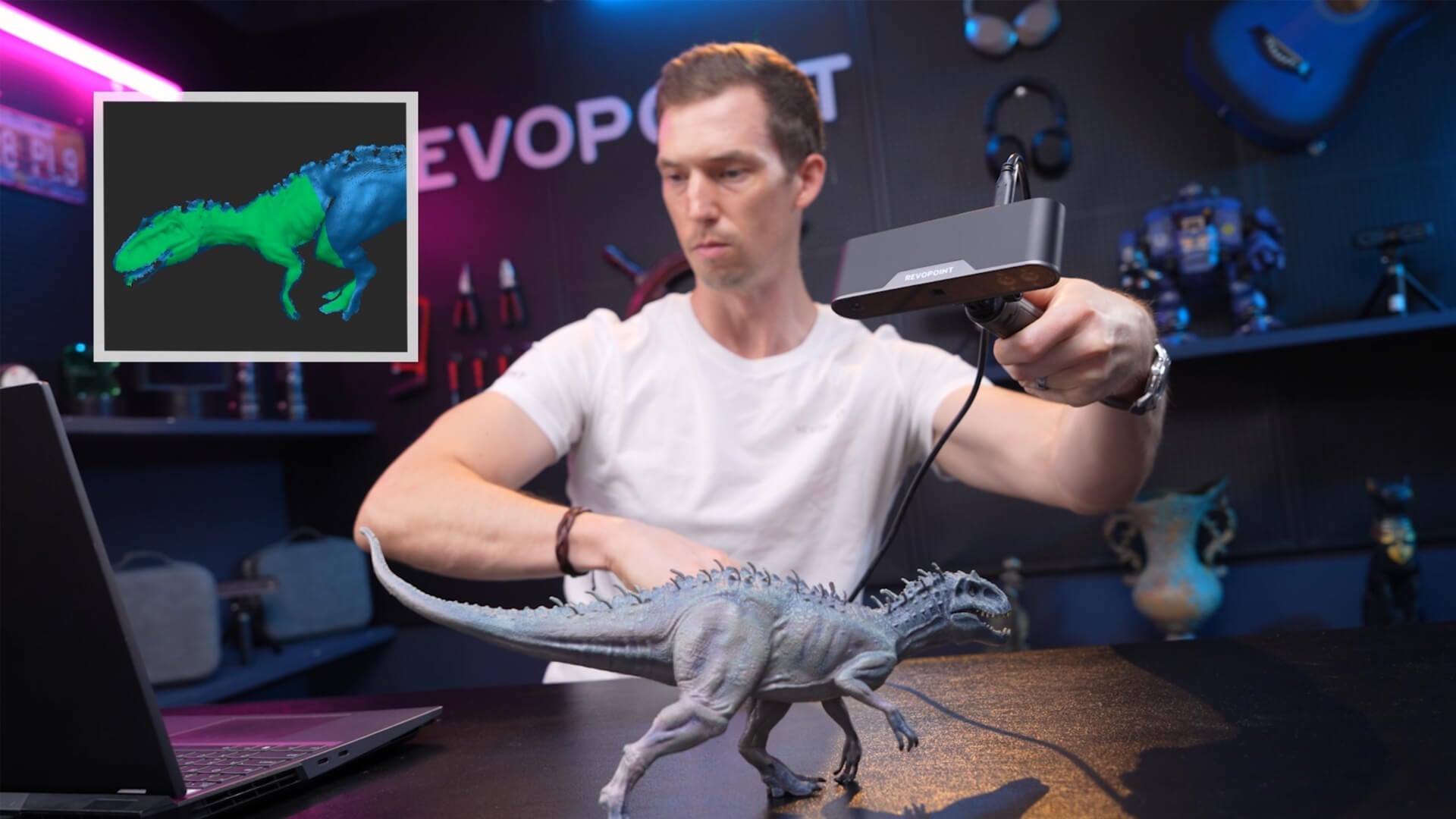
At the same time, startups like Revopoint emerged to make 3D scanning more accessible by balancing affordability and portability, helping small businesses, educators, and consumers.

Meanwhile, open-source developers developed mesh-repair and point-cloud tools such as MeshLab and CloudCompare, motivated by a desire to no longer be bound by proprietary systems.
While affordable options grew quickly, high-end professional systems advanced rapidly as well. Companies like Creaform and Artec pushed forward the accuracy, speed, and metrology-grade reliability of 3D scanning systems. Their handheld laser and structured-light systems became the industry standard for engineering, medical, and industrial processes.


Hinterlasse einen Kommentar
Diese Website ist durch hCaptcha geschützt und es gelten die allgemeinen Geschäftsbedingungen und Datenschutzbestimmungen von hCaptcha.