


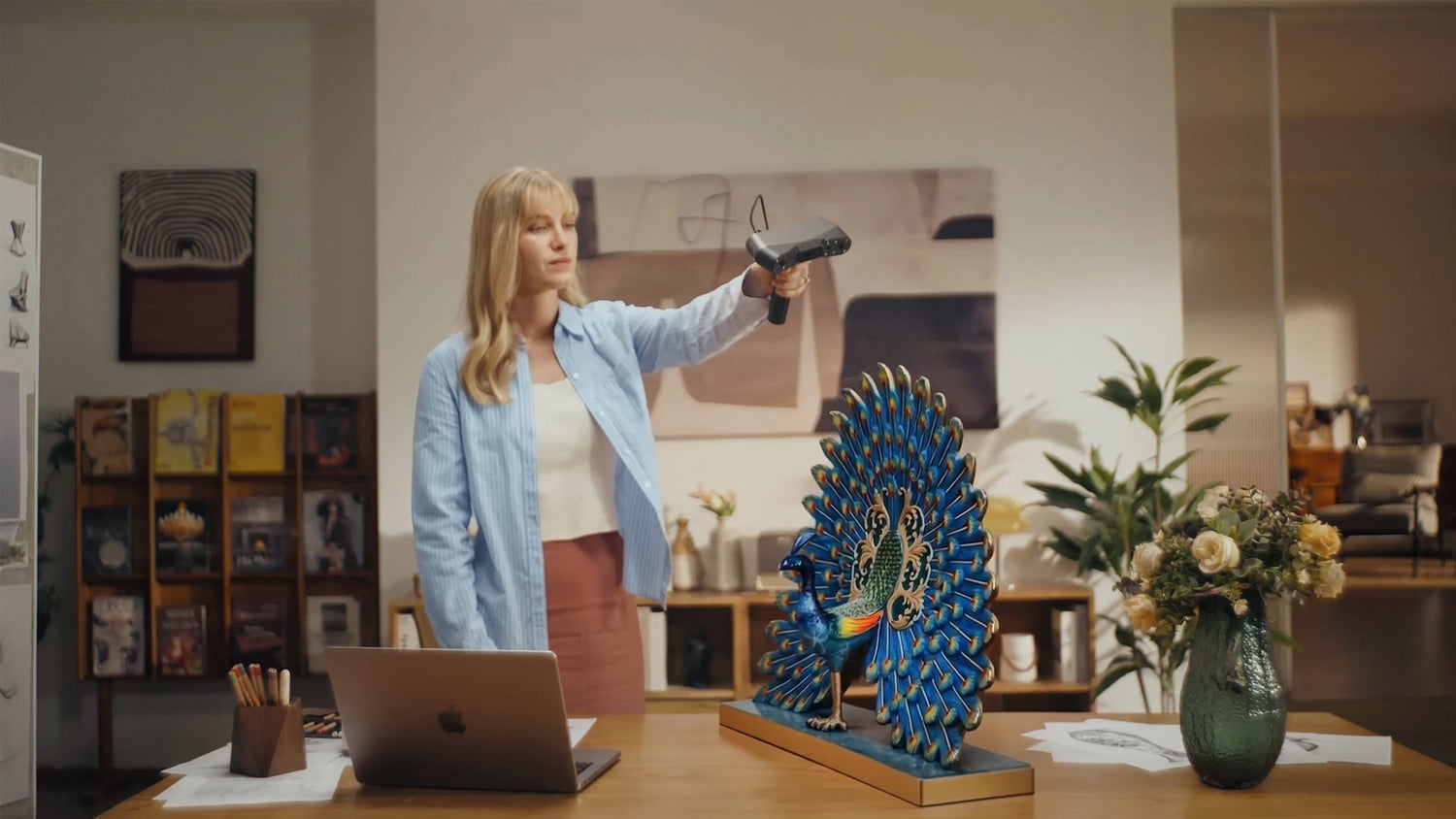
For decades, computer graphics have been built around representing the world as geometry. Everything from video game environments to architectural renders has relied on meshes, usually composed of triangles stitched together to form surfaces.
But a newer approach called Gaussian splats is changing how we reconstruct reality from images. Recently launched on Kickstarter, the POP 4 3D scanner offers a new hybrid Gaussian splat type that combines accurate geometry with high visual fidelity.

Its Definition
Gaussian splats are tiny, soft blobs in 3D space that store position (where it exists in space), color (what it looks like), size (how big the blob is), and transparency (how it blends with others).
By itself, a single Gaussian blob looks meaningless, but when placed alongside millions of them, they form a complete, photorealistic 3D scene. Basically, instead of drawing surfaces, the system is essentially painting the world with volumetric points of light.
Why It Exists
Traditional 3D graphics uses meshes, which are made of hundreds to millions of flat triangles connected to form surfaces.
Meshes generally work well for games, engineering models, CAD designs, and animation assets. However, meshes can struggle to recreate messy real-world details like hair, trees, reflections, fine textures, and lighting variations.
To solve this, researchers began focusing less on perfect geometry and more on how a scene appears from any angle, leading to Gaussian splats.
How Gaussian Splats Are Usually Created
The process usually starts with photos or videos of a real scene taken from many angles. Then, algorithms analyze the images and estimate the locations of points in 3D space. Instead of connecting those points into surfaces, it assigns each one a splat. Each splat carries color, size, and transparency data, and when rendered, the splats overlap and blend together to create something akin to a 3D cloud that looks solid when viewed.
How Gaussian Splats Are Created with POP 4
Unlike regular Gaussian splats, the POP 4 combines geometry and Gaussian splats to first create an accurate model, then turn it into an ultra-realistic 3D Gaussian model.

Point Cloud Capture
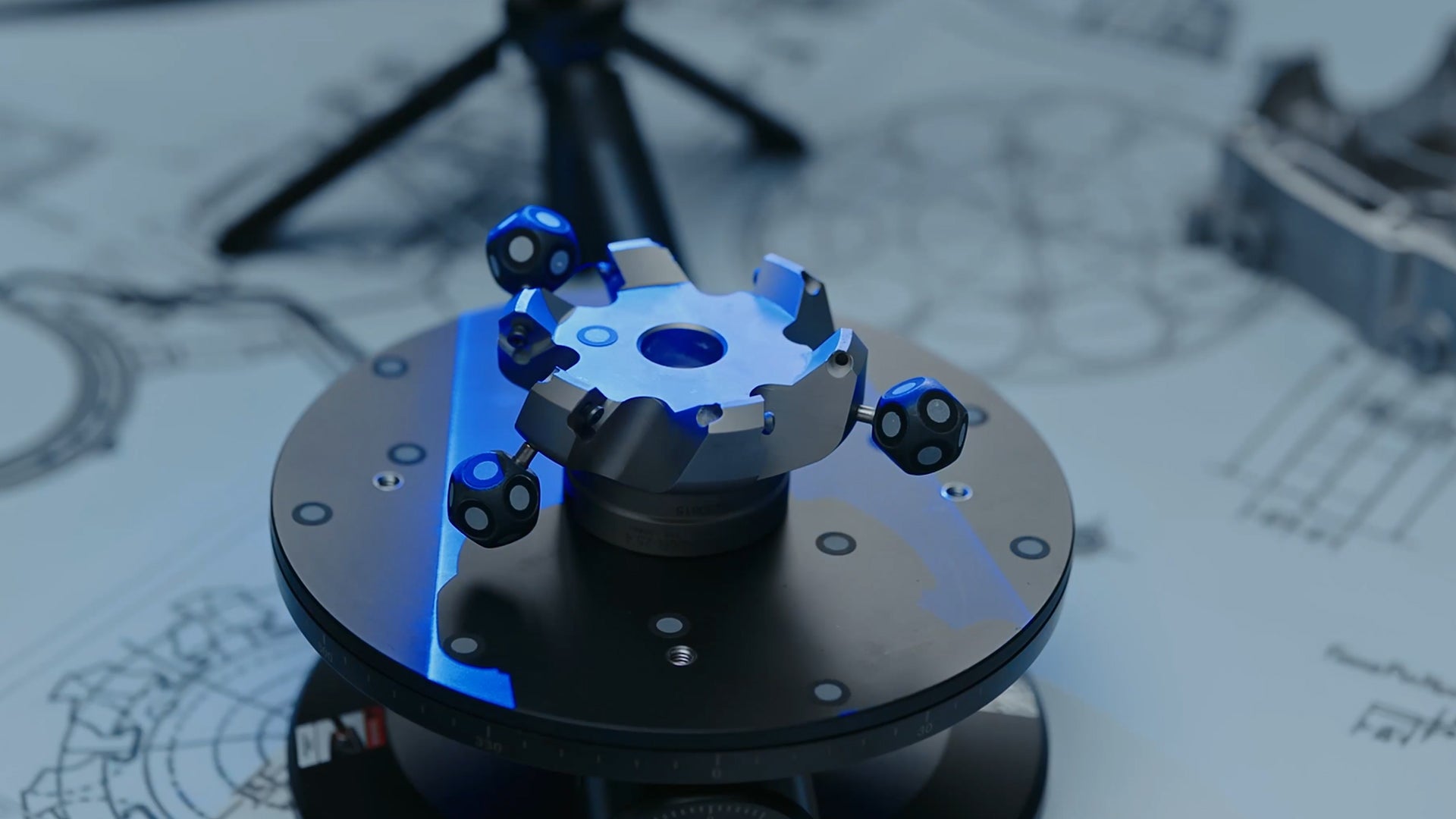
First, you use the POP 4 to scan the object and capture accurate point cloud data representing its geometry.
Mesh Reconstruction
You then, in Revo Scan 6, process the point cloud in a standard 3D mesh, providing a solid and measurable structure.
Gaussian Splat Capture
Next, you use the POP 4’s RGB camera to capture the object’s visual data from all sides.
Splat-to-Mesh Projection
Finally, in Revo Scan 6, the splats are mapped onto the mesh, enriching it with high-fidelity color, lighting, and fine visual detail.
With this innovative hybrid approach, you get both structural accuracy and improved visual realism.

How They Look
When rendered, Gaussian 3D models usually look like very realistic duplicates of the original object. This realism is due to lightning that feels natural and continuous, regardless of the viewing angle. Also, fine details, such as foliage or hair, are much better preserved than in meshes.
Gaussian 3D models can also be viewed smoothly from different angles, with a view-dependent appearance learned from previously captured images, making environments or objects feel more real than manually constructed ones.
Gaussian Splats vs Traditional 3D Models
A useful way to think about it is that traditional mesh-based 3D models build the world like a sculpture, while Gaussian splats reconstruct the way light fills a space. One prioritizes structure. The other prioritizes appearance. That difference is why splats can look so lifelike, even though they do not behave like conventional models.
This is what makes POP 4’s Gaussian splatting mode special. As you no longer have to choose between the two, as POP 4 blends both accurate geometry and appearance to create a superior Gaussian 3D model.
POP 4 is now available on Kickstarter, starting at just $579.


Leave a comment
This site is protected by hCaptcha and the hCaptcha Privacy Policy and Terms of Service apply.